
Home | Territory | Countries and locations | St. Peter’s
St. Peter’s
San Pietro di Cadore is the easternmost municipality in the valley, in the area where the Piave river originates. Among historic buildings, villages, wooden houses and open landscapes on the peaks, it tells one of the most recognizable and identifying faces of Comelico. It is the place where architecture, craftsmanship and the alpine landscape meet most clearly.
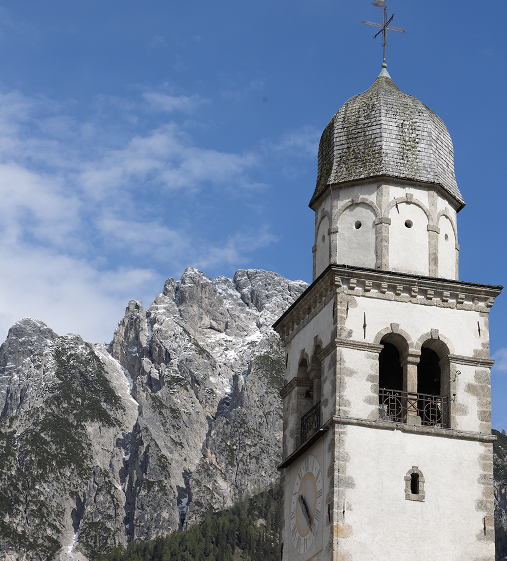
San Pietro, dominated by the peaks of Peralba, Monte Zovo and Terze, and guardian of the source of the Piave, combines landscape value, architecture and local memory. In the capital stands the historic Poli-de Pol palace; in the sea there is Villa Poli-de Pol-Sammartini, considered the northernmost Venetian villa ever built.
The church of San Pietro Apostolo, in Gothic style as a license, is one of the most recognizable architectural references in the valley; in Presenaio the same style is mixed with classical elements. Costalta is a village built entirely of wood, with sculptures by local artisans that animate the streets of the village: here is the Casa “Angiul Sai” Ethnographic Museum, a journey through the life and traditional crafts of Comelico.
Presenaio
Lying along the road to Sappada, downstream from the capital, Presenaio is the lower gateway to the territory of San Pietro di Cadore. The town stretches out at the bottom of the Val Comelico, between meadows and wooded slopes, in a position that has always made it a place of passage.
Its most precious element is the Church of San Volfango, one of the oldest in the valley: erected in the fourteenth century and consecrated in 1420, it preserves the late Gothic architecture of Cadore, with a gabled roof covered in shingles and a pyramid bell tower. Not far away is Salafossa, testimony to the ancient mining vocation of the area and the long industriousness of the local community. A village that tells, without fanfare, the origins of Comelico.

Valley
In an elevated position on the sunny side of Val Comelico, Valle offers a wide view of the valley and the surrounding peaks. The heart of the village is the Church of San Giovanni Battista, from the sixteenth century, with its simple and essential alpine architecture.
All around, open pastures and coniferous forests preserve the atmosphere of the mountain villages of yesteryear. It is the ideal starting point for leisurely walks along the paths in the area.
Costalta
Lying at about 1,300 meters on the slopes of Mount Zovo, Costalta has made wood its identity. Known as “the village of wood”, it preserves an architectural heritage of ancient houses and barns built with the historic Blockbau technique.
Walking through the alleys you will come across open-air wooden sculptures and the Angiul Sai House Museum, the heart of local memory. From its panoramic position, the village overlooks the peaks of the Dolomites, in a cozy atmosphere and in direct contact with nature.
Sea
In an elevated position on the sunny side of Val Comelico, Valle offers a wide view of the valley and the surrounding peaks. The heart of the village is the Church of San Giovanni Battista, from the sixteenth century, with its simple and essential alpine architecture.
All around, open pastures and coniferous forests preserve the atmosphere of the mountain villages of yesteryear. It is the ideal starting point for leisurely walks along the paths in the area.


