
Ladin culture
In Comelico, Ladin culture is a living presence, not just a memory of the past. Language, traditions, knowledge, festivals, forms of living and relationship with the territory tell of a strong, recognizable identity that is still deeply rooted in the life of the valley.
The Ladin culture is one of the most distinctive elements of Comelico. It does not only concern the language, but an entire way of living in the mountains, of handing down knowledge, of building relationships with the territory and of recognizing oneself in a common history.
The Ladin
In Comelico Ladin is spoken, a Rhaeto-Romance language of ancient origin. It is believed that it began to be formed in the first centuries after Christ, from the fusion of the Latin of the Roman legions with the speeches of the local populations.
Despite centuries of domination, the language has survived and is now one of the oldest in Europe.
About 45,000 people speak it worldwide, distributed between Graubünden in Switzerland, Val Gardena and Val Badia in South Tyrol, Comelico and Friuli.
In the valley it is kept alive with pride, taught to the new generations and declined in different local idioms from municipality to municipality.
Ladin traditions
Some traditions have remained in the memory, others are still alive and repeated every year exactly as in the past. Among those that have disappeared is the clònpär, the itinerant welder of buckets and pots who set up his small forge in the town squares.
Among those still alive, carpenters, luthiers and antique dealers represent the most recognizable artistic craftsmanship of the valley.
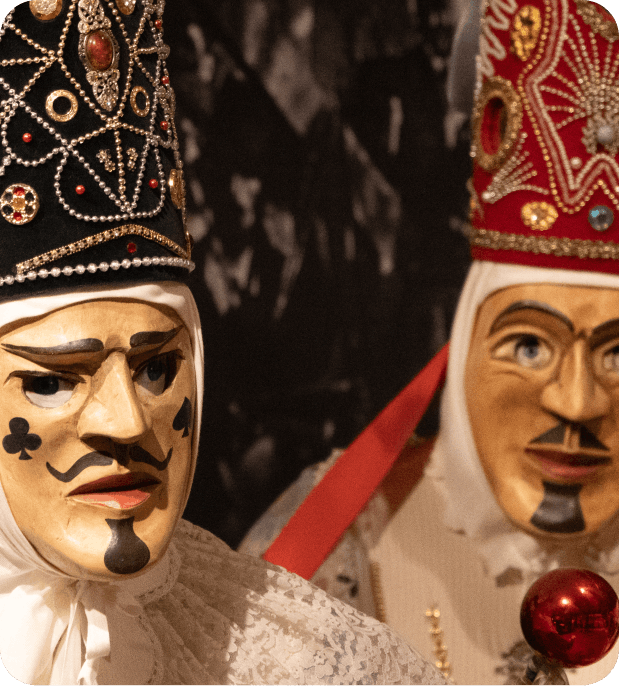
The most awaited tradition, however, is the Carnival: every year the Maskarada travels through the villages with its dancing procession, the wooden masks of Lachè and Matazin carved by local artisans according to shapes handed down for centuries. An ancient ritual that attracts thousands of people every year.
The rules
The Rules of Family Communion of Comelico are one of the oldest institutions in the valley: established by the Counts of Camino over a thousand years ago, they are still active in sixteen communities today. This is how they work: the families that are part of it hand down from generation to generation the common ownership of woods and pastures, together with the commitment to preserve and enhance them.
The rules are contained in the Laudi Statuti, ancient rural codes approved by the democratic assembly of the regolieri. Since 1971 the Regole have been private law companies, but their role in the protection of the mountain environment — and in the identity of the territory — has remained intact. The woods cared for by the Regole are now one of the most recognizable elements of the Comelico landscape.
Discovering the Ladin culture means getting in touch with an original and still very present identity, capable of making the Comelico different, deep and immediately recognizable.


